Readings in.
Certificate out.
Certorum runs a field testing business: every unit on its cycle, readings checked against the standard as you type, and the report and invoice done before you leave the site.
Free for up to 40 units · No card required · Works offline on site
Built for the standard you test to.
- Available now
Cabinet, fume hood & cleanroom certification
For field certifiers testing biosafety cabinets, fume hoods, clean benches, isolators and pharmacy cleanrooms.
- NSF/ANSI 49
- ASHRAE 110
- ISO 14644-1
- USP <797>
- Readings checked against the standard as you type, even offline
- Certificates, failure reports and USP <797> site summaries
- Recertification cycles, reminders, quotes, invoices and a customer portal
- Available now
Commercial scale service
For registered service agencies testing, repairing and placing commercial scales in service.
- NIST Handbook 44
- Handbook 130
- Handbook 44 maintenance and acceptance tolerances checked at every test load
- As-found and as-left test reports, and placed-in-service reports
- Test weights on record, scheduling, invoicing and a customer portal
Acceptance criteria built in for
- NSF/ANSI 49
- ASHRAE 110
- ISO 14644-1
- USP <797>
- NIST Handbook 44
From the van to the invoice, in one place.
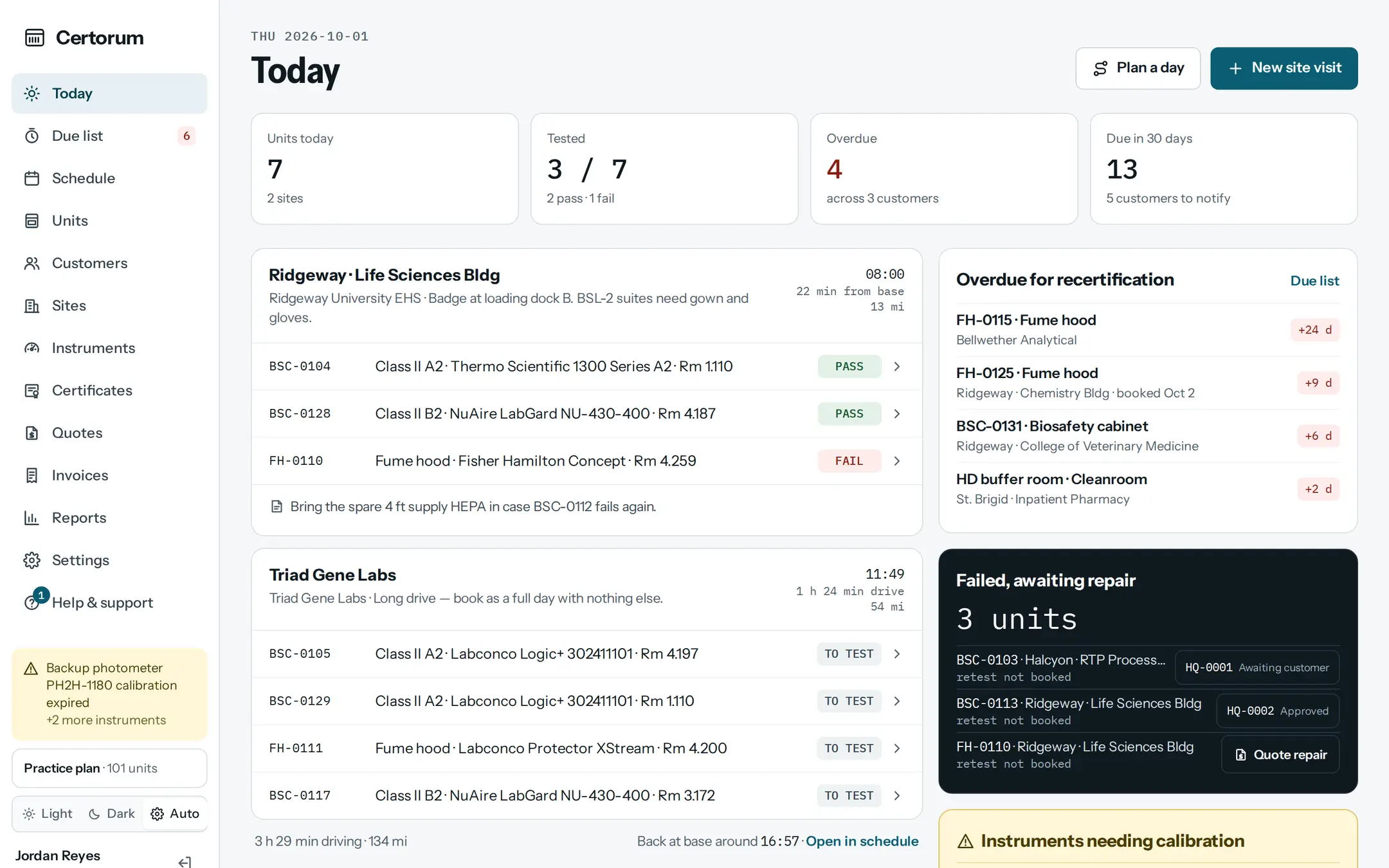
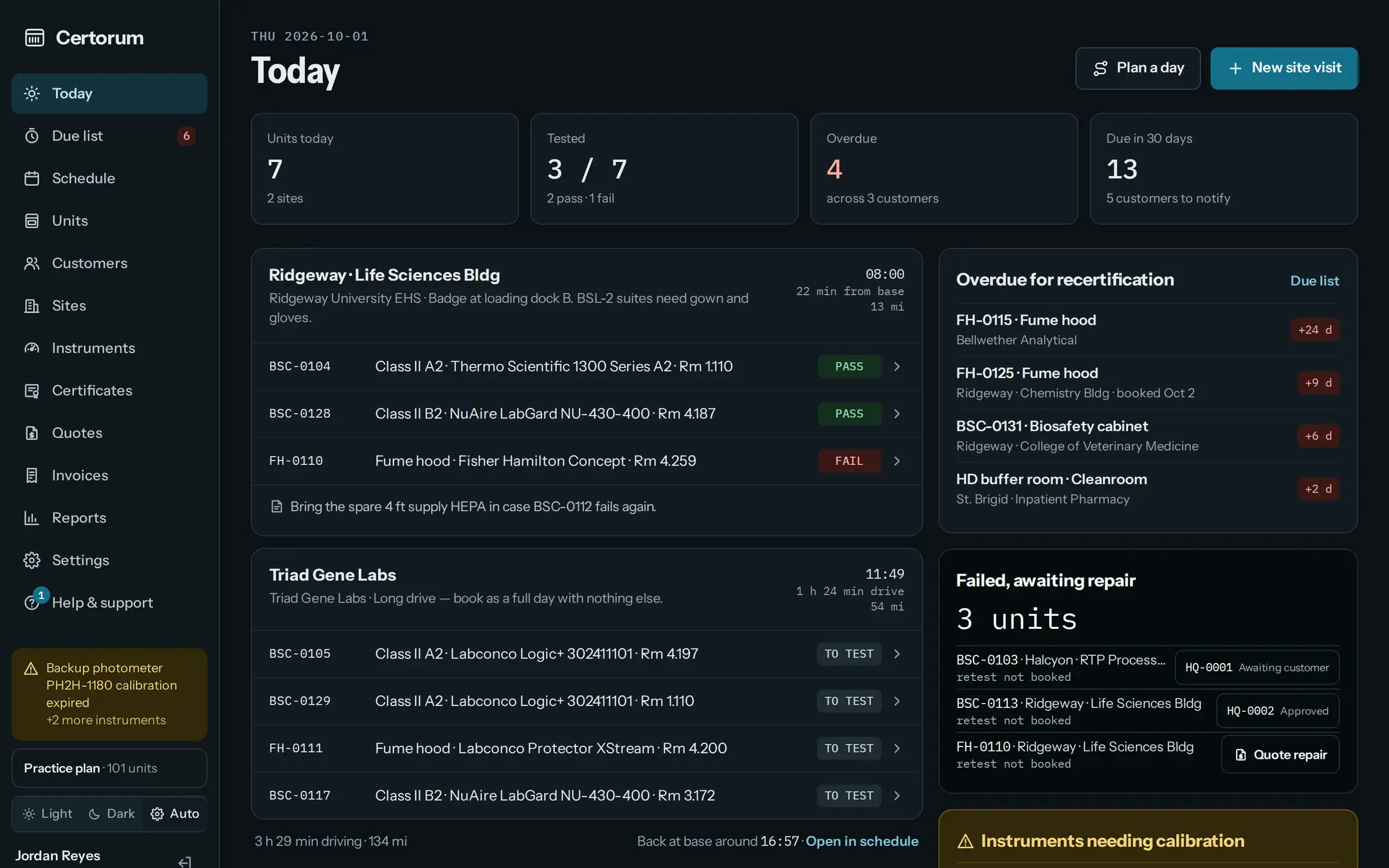
Certorum follows the job the way you work it — not the way a generic field-service tool thinks you should. Shown here for cabinet and cleanroom certification; scale service follows the same flow.
- 01Plan
Know what’s due before your customers do.
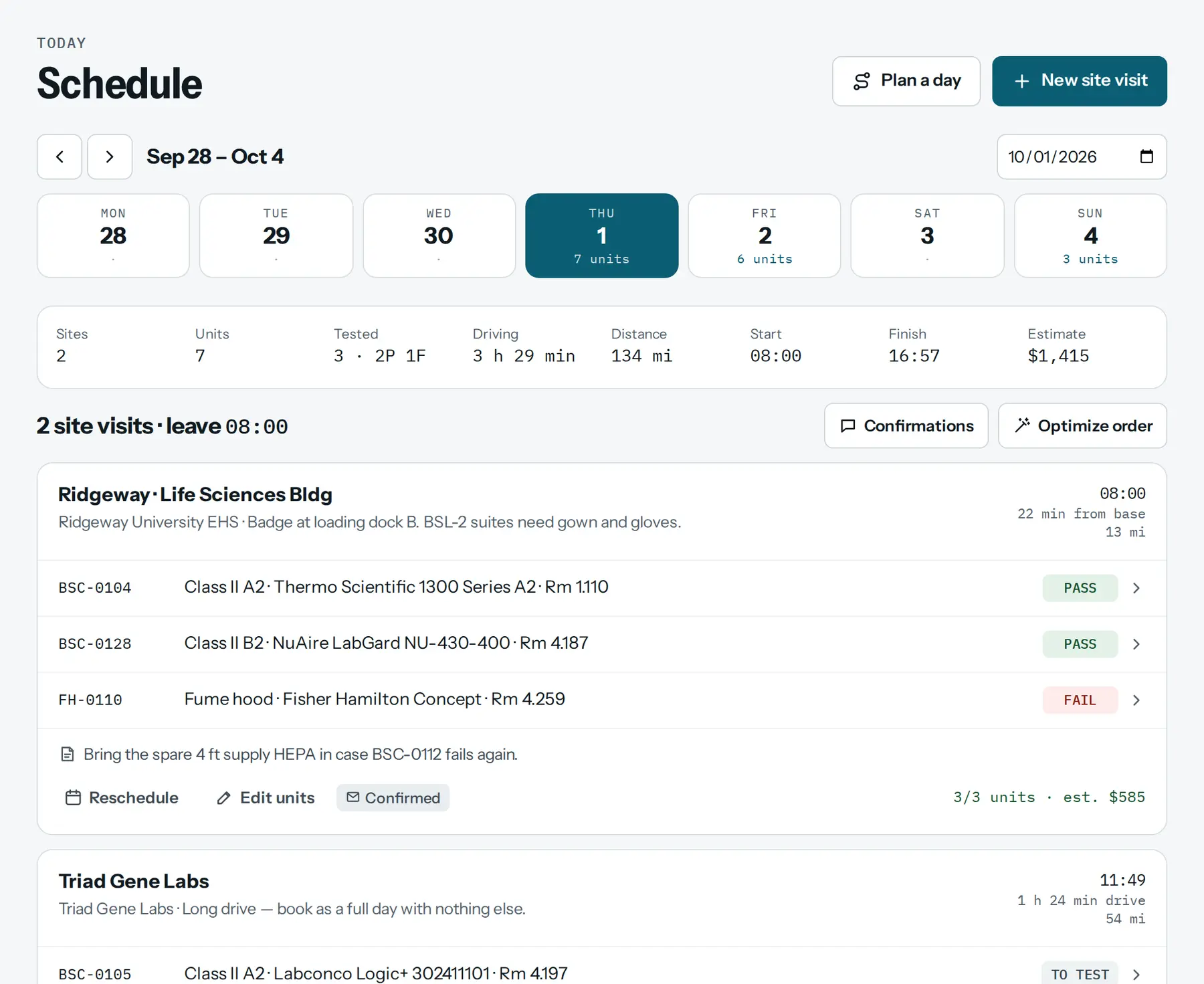
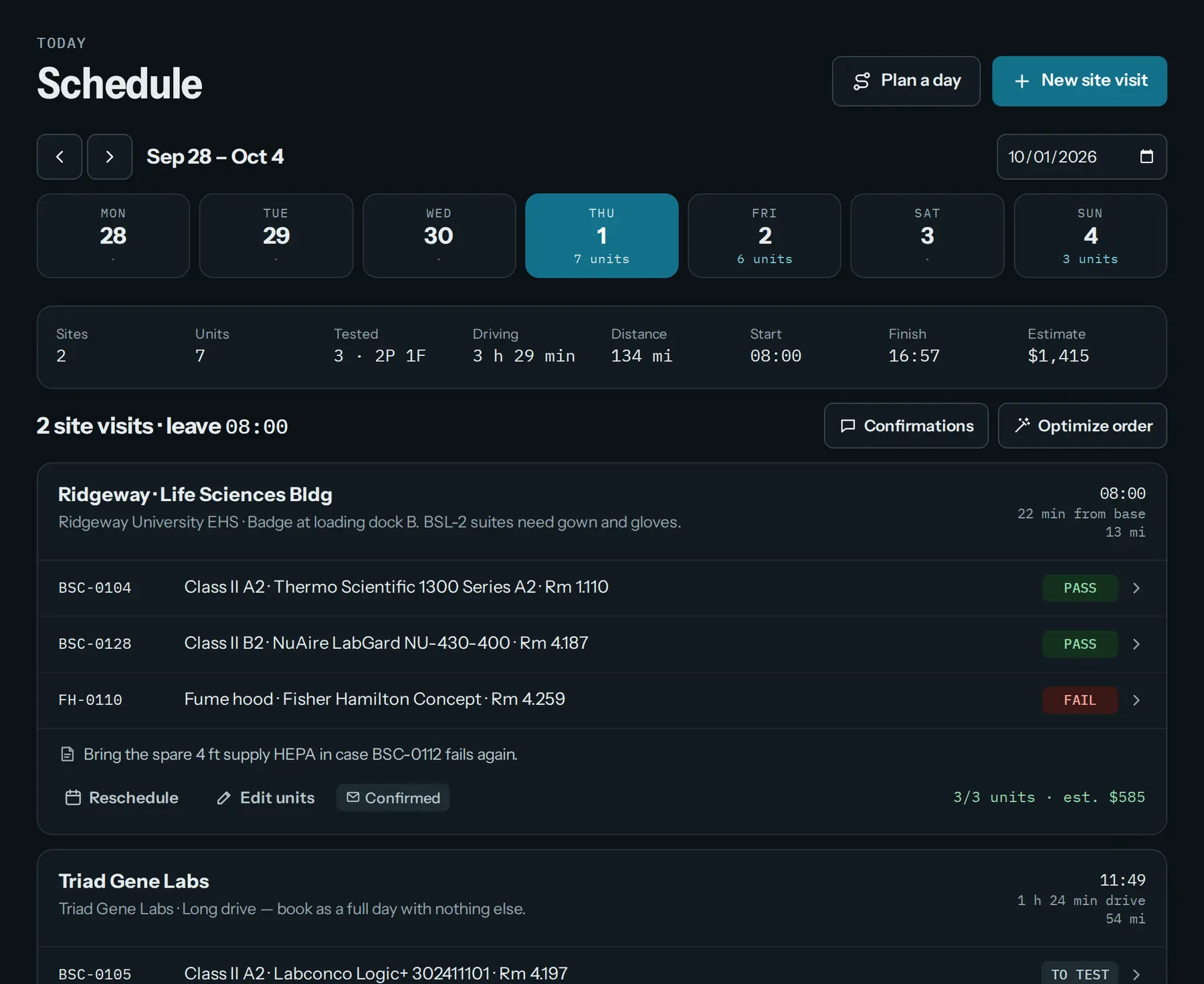
Every cabinet, hood and cleanroom sits on its own recertification cycle. The due list shows what’s coming by customer and site, and the schedule turns it into a day you can actually drive.
- Due and overdue units across every customer, 30 to 180 days out
- Site visits ordered into a route with drive times and a finish estimate
- Badge, gowning and access notes for each lab, right on the day
- 02Test
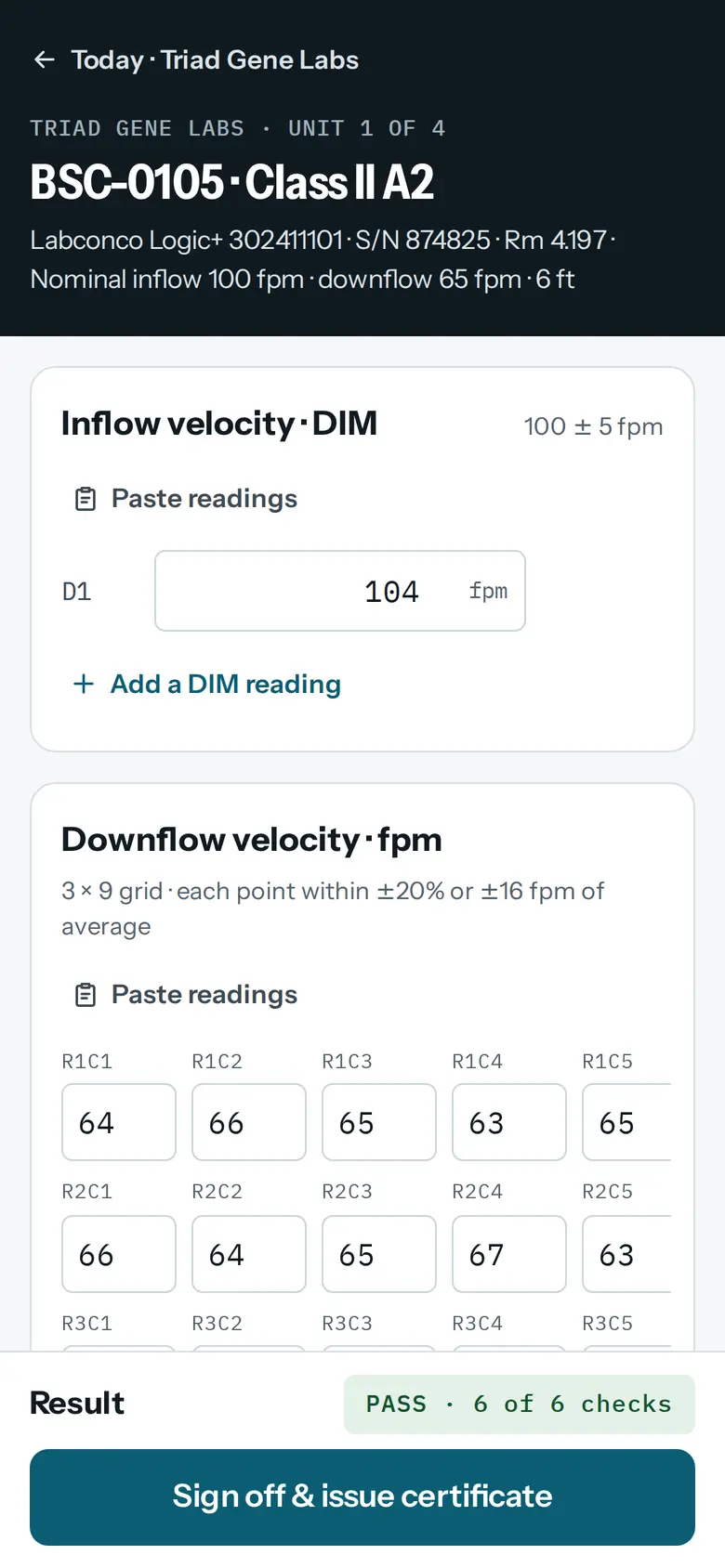
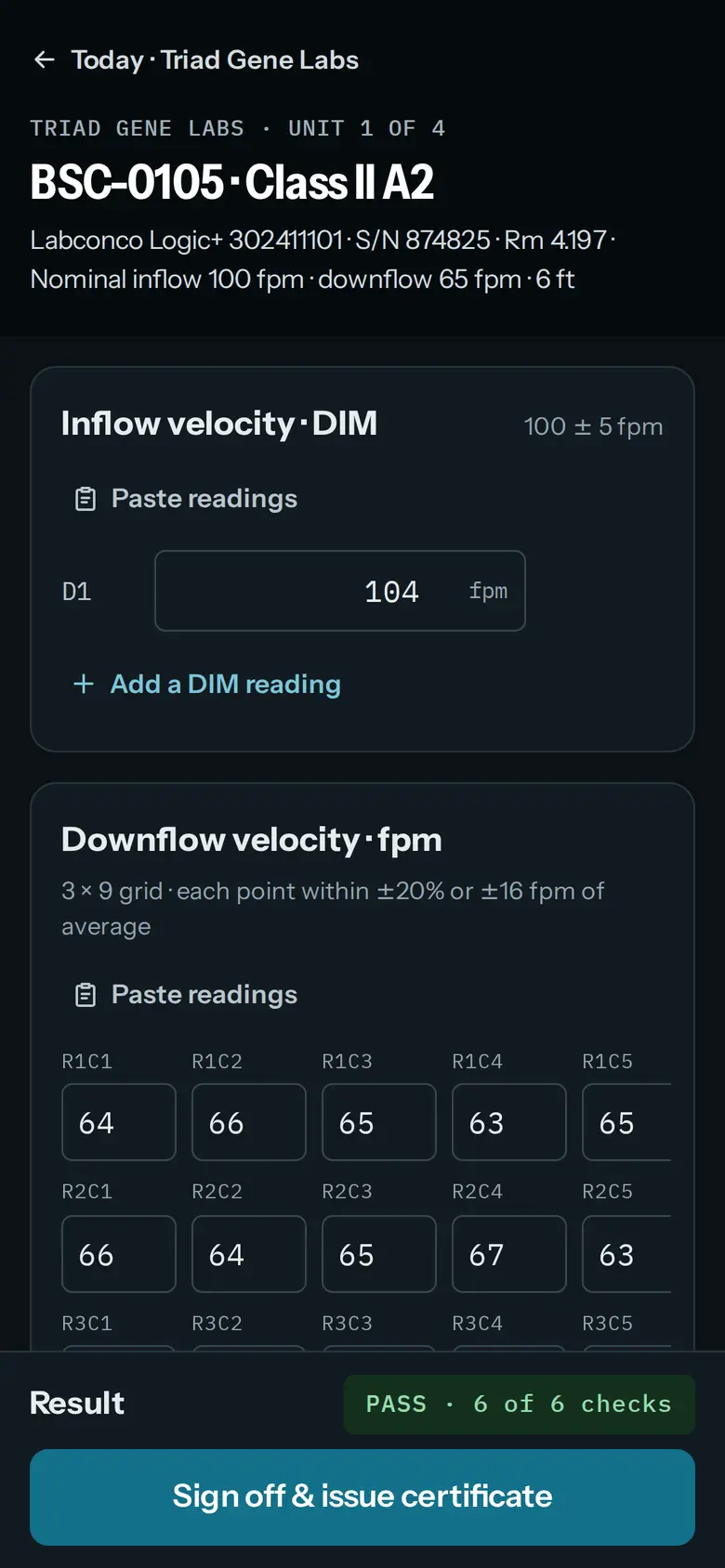
Pass or fail as you type — even with no signal.
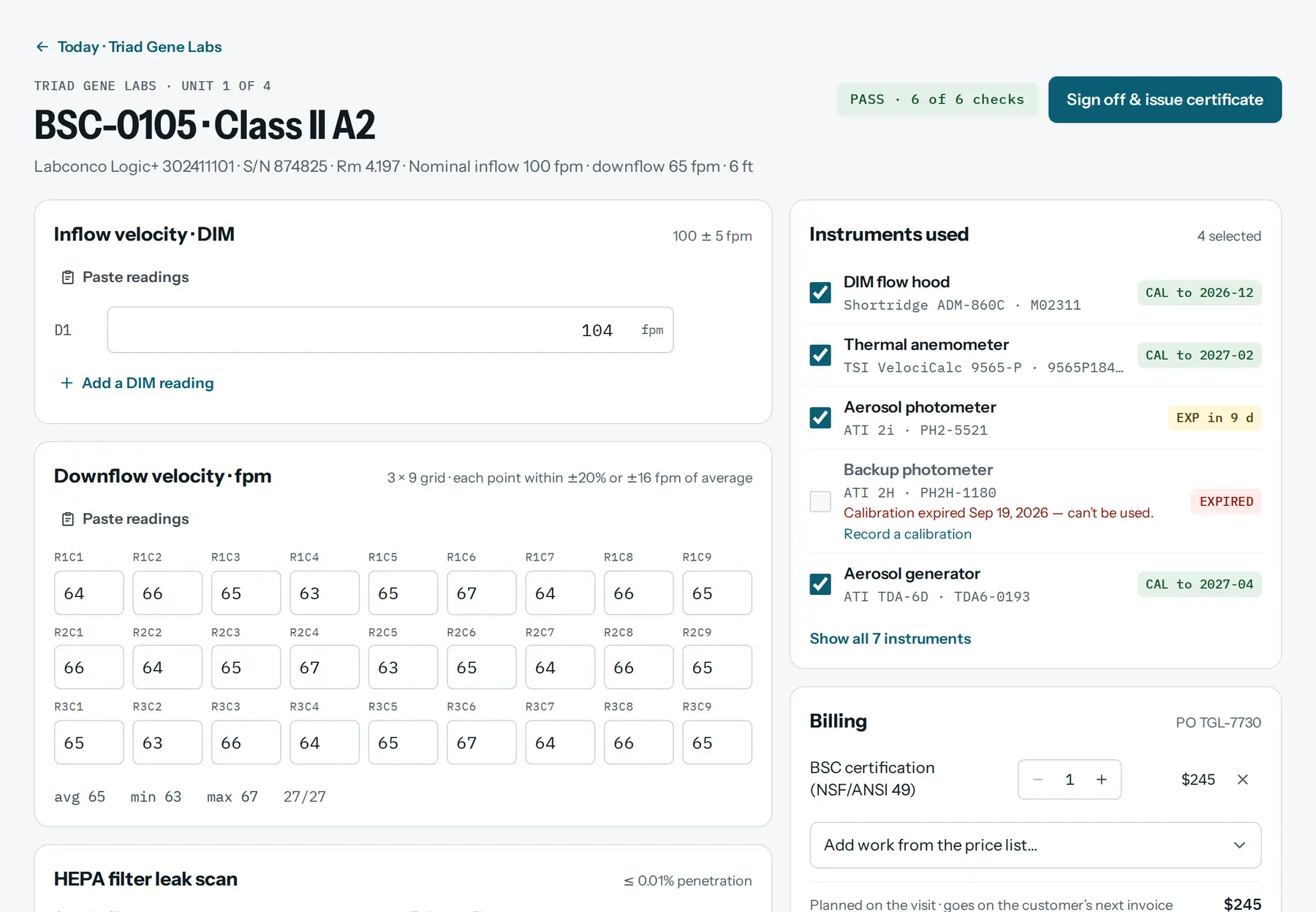
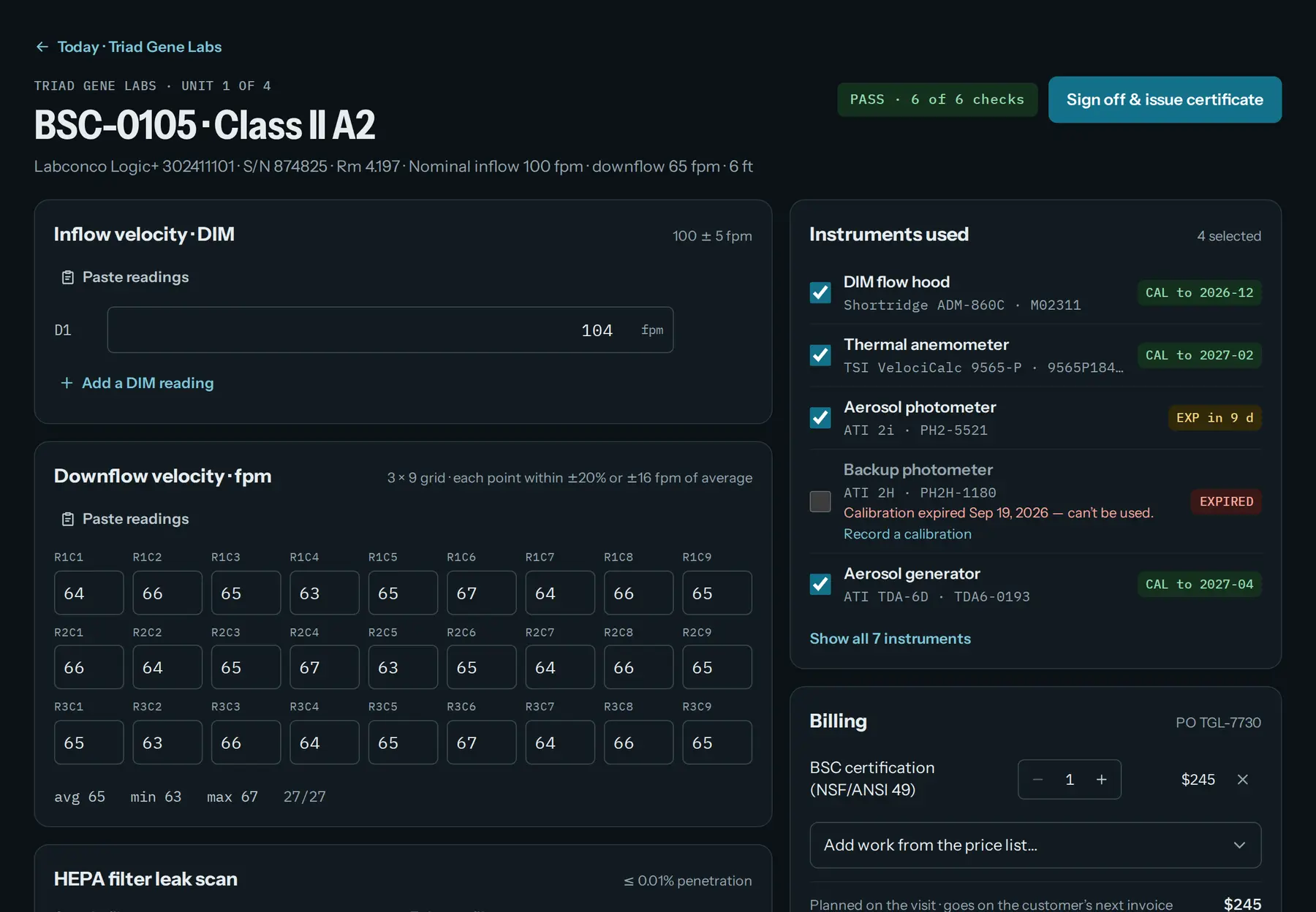
Enter readings on a laptop, tablet or phone and see each check against the standard immediately. No spreadsheet formulas, no second pass back at the office.
- Inflow, downflow grids, HEPA leak, face velocity and particle counts checked live
- Paste columns from a spreadsheet or import a particle-counter CSV
- Instruments with expired calibration can’t be used to sign off
- Keeps working offline in basements and cleanrooms, and syncs when you’re back
- 03Certify
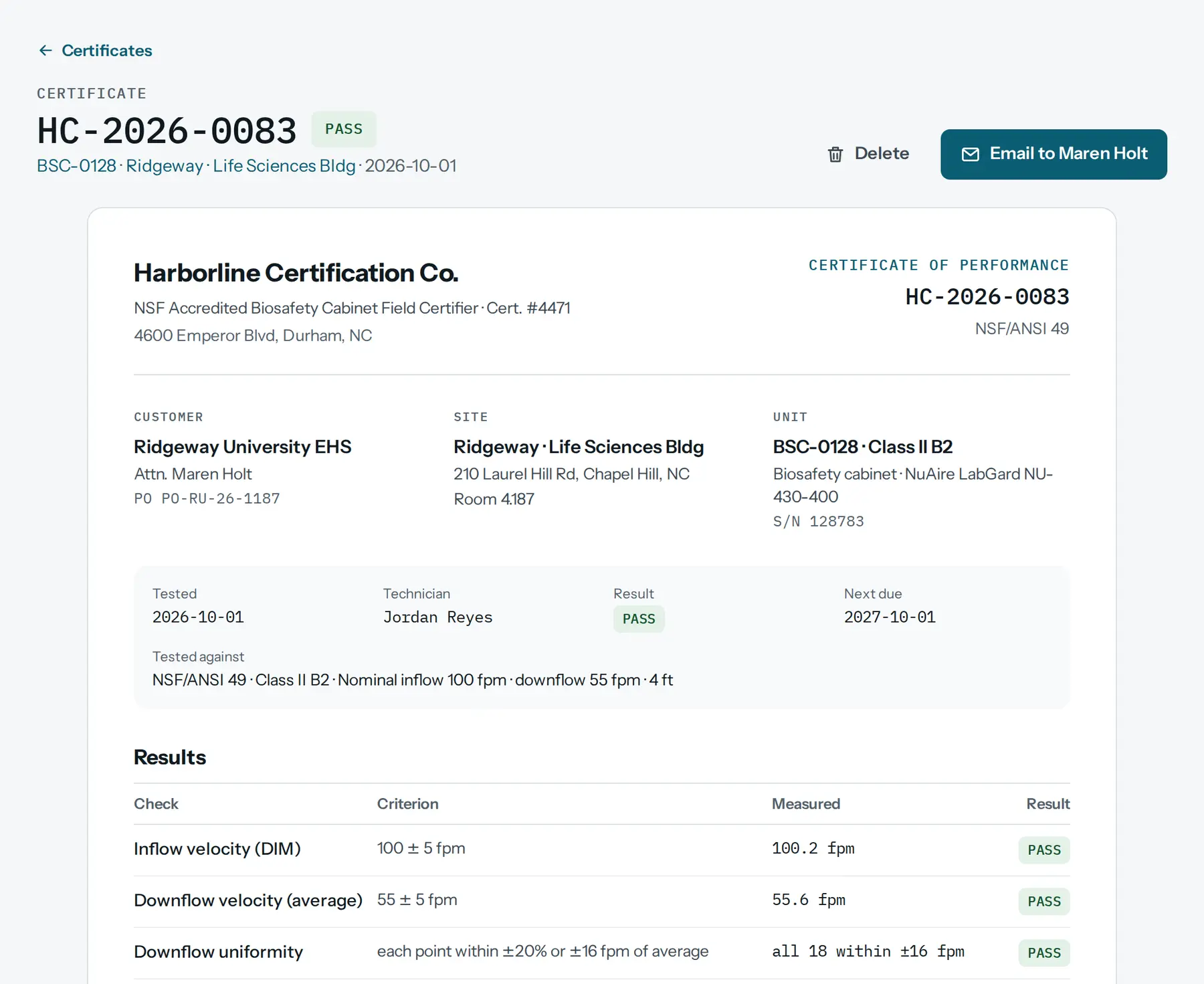
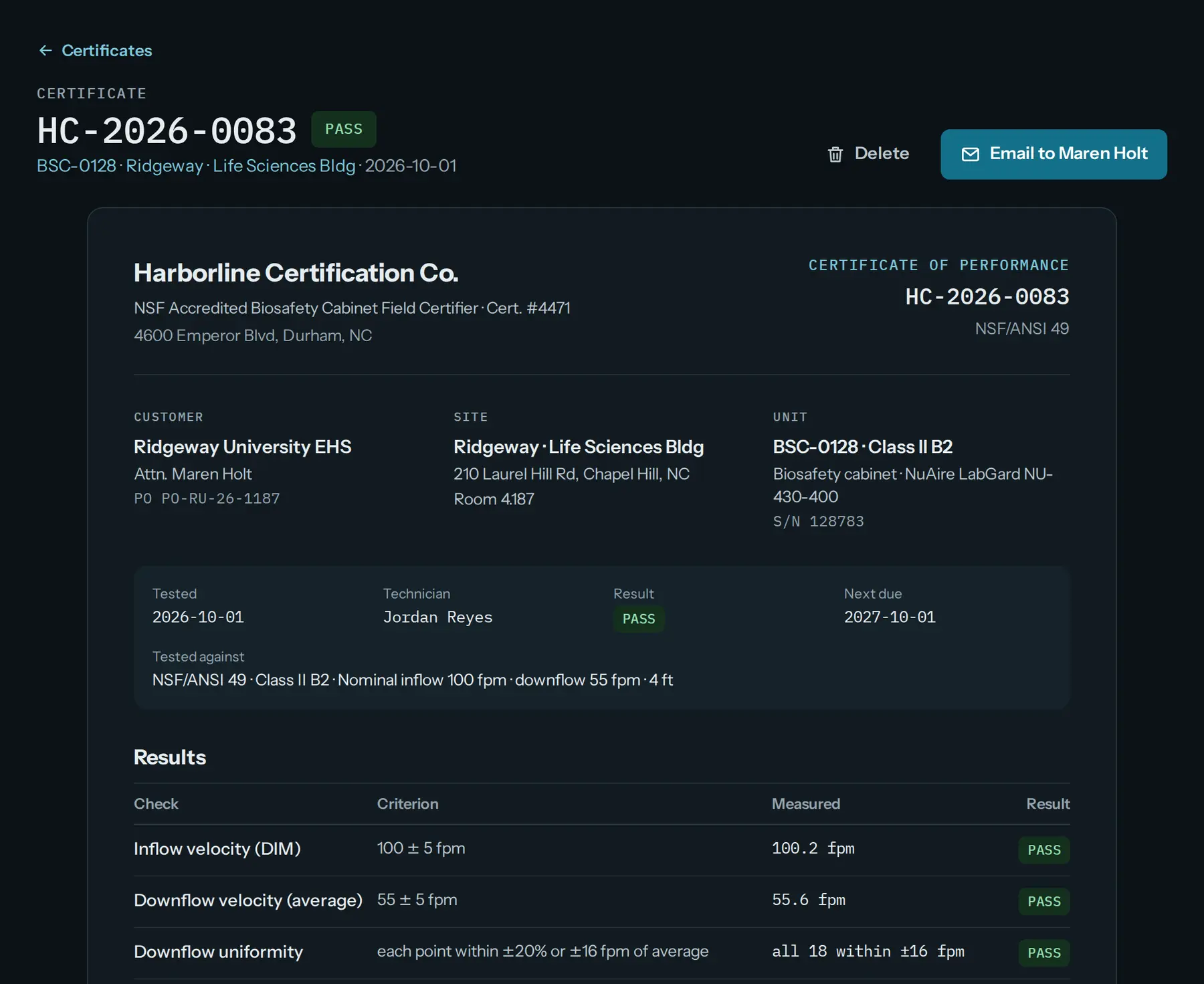
A certificate your customers can audit.
Sign off and the certificate is numbered and ready: every reading, the criterion it was held to, the instruments used and the next due date. A failure becomes a repair report instead.
- Certificates of performance and failure reports, with your accreditation
- Turn a failed check into a repair quote in one step
- Customers download their certificates from their own portal
- 04Get paid
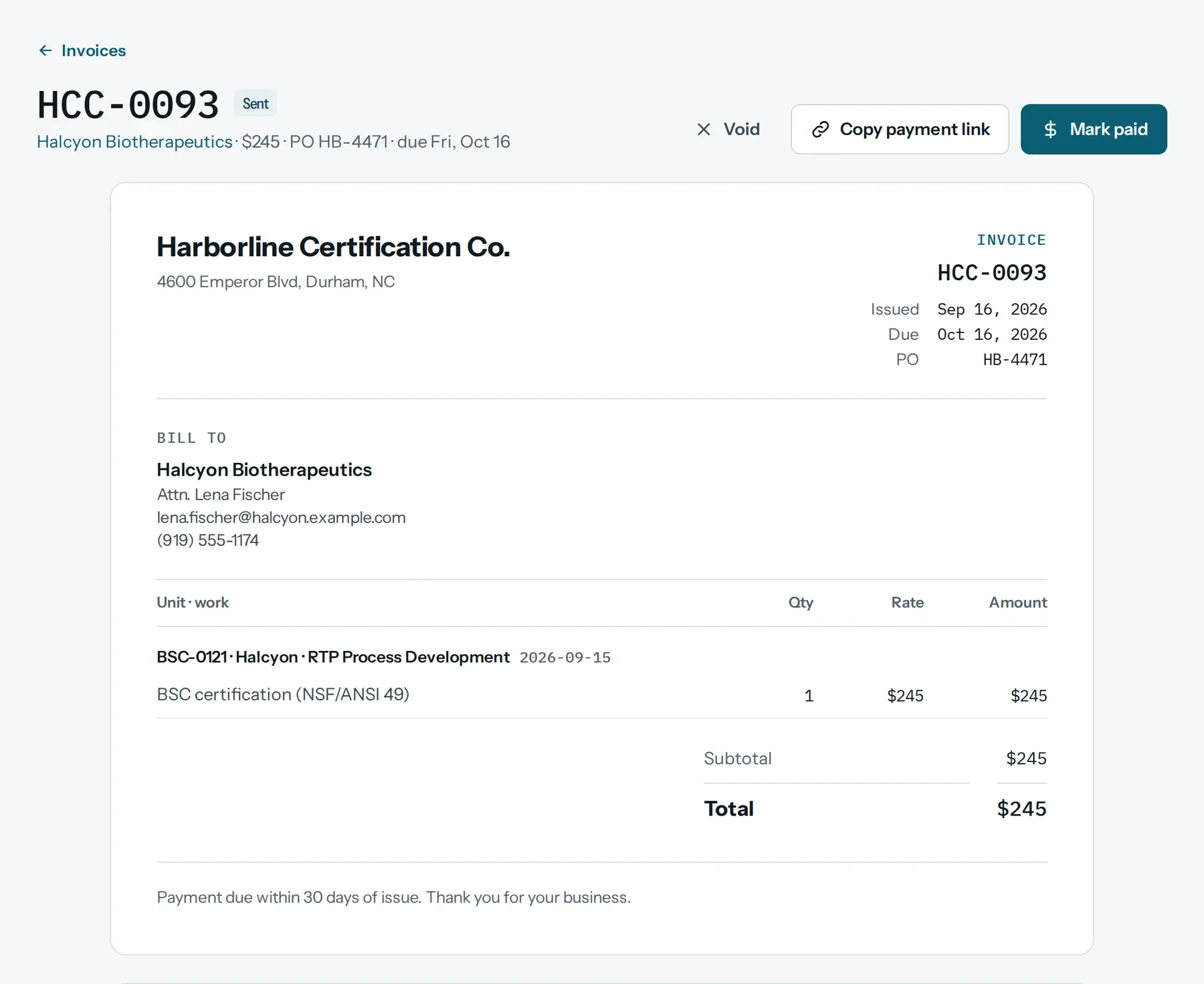
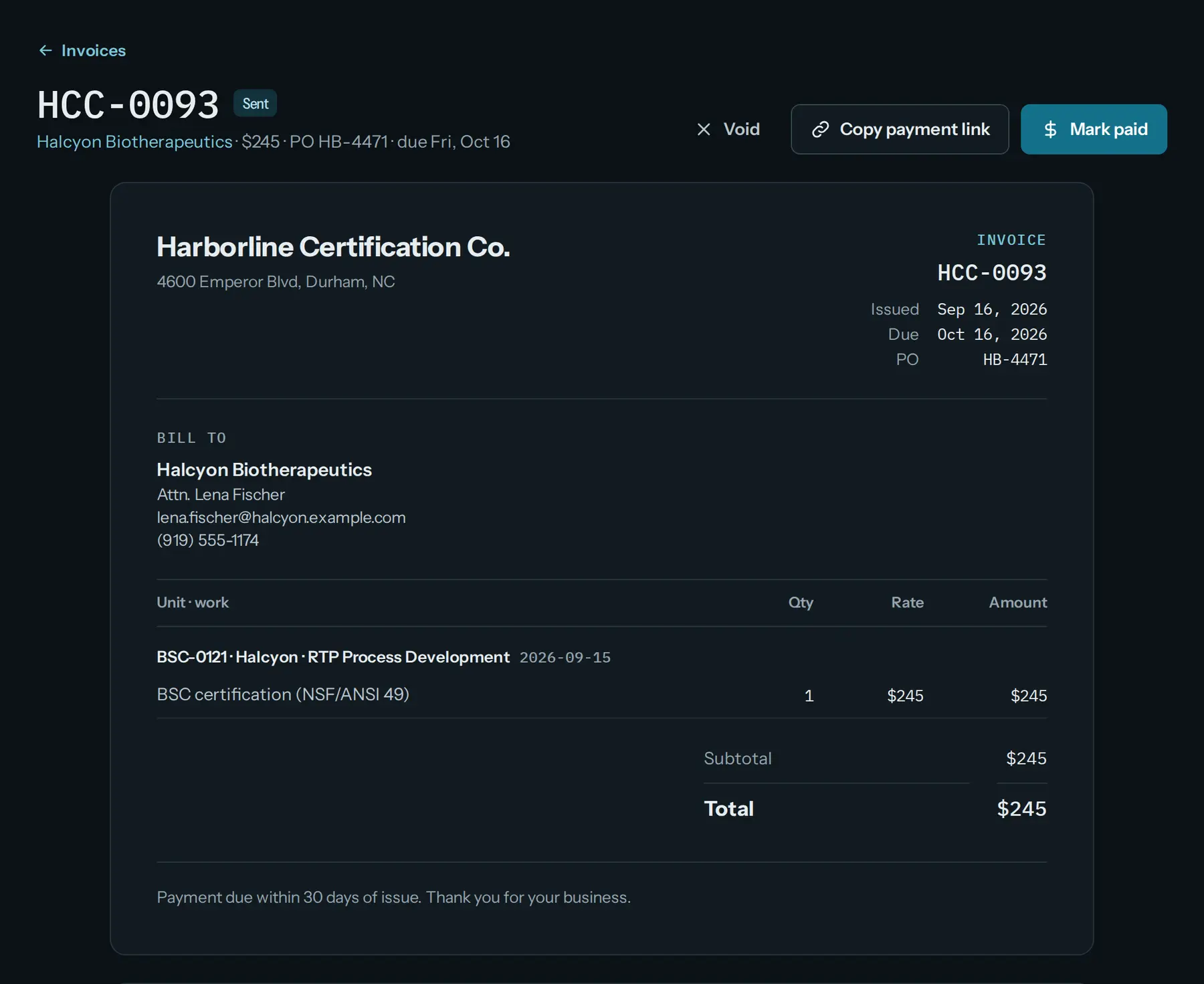
Invoice before you’re back in the van.
Every unit tested at every site rolls into the customer’s invoice from your price list, with their PO number. Send it in one click and see what’s paid and what’s overdue.
- One invoice per customer and visit, built from the work you signed off
- Automatic payment reminders, and a tap to mark checks and transfers paid
- Quotes, invoices and payments tracked in one place
Everything a testing business runs on.
The parts of the job that used to live in spreadsheets, inboxes and a binder in the truck.
Customer portal
Labs sign in with an emailed link to see their units, certificates, quotes and invoices. No more “can you resend the cert?”
Works offline
Enter readings and sign off tests with no signal. Everything syncs on its own when you’re back online.
- Practice+
Recertification notices
Due-soon notices go to each customer automatically, grouped by site, so they book you before the date.
Calibration tracking
Every test records the anemometer, photometer and counter used. You’re warned before a calibration lapses.
Quotes
Quote repairs and new work from your price list. Customers approve them in the portal.
Readings import
Paste a column from a spreadsheet or meter app, or import the CSV your particle counter exports.
- Practice+
Reports & export
Revenue, pass rates and overdue units at a glance, and CSV exports of everything.
- Fleet+
Your team
Technicians with their own sign-ins and a shared pool of instruments across vans.
Audit-ready from the first test.
Your customers answer to inspectors and accreditors. Certorum keeps the record you’d want them to see.
Tamper-evident history
Every change to tests, certificates and invoices is written to a hash-chained audit trail you can verify at any time.
Two-step sign-in
Authenticator-app codes for every user, with recovery codes for a lost phone.
Encrypted and separated
Encrypted in transit, sensitive secrets encrypted at rest, and every business’s records kept apart.
Your data, always
Export everything whenever you like, and close your account yourself — no phone call, no lock-in.
One tech or a fleet of vans.
Start free and move up when your book does. Practice and Fleet are free for your first 60 days, no card needed. Month to month, cancel any time.
Field
For an independent certifier getting started.
- Up to 40 units
- Test entry & pass/fail limits
- Certificates
- Invoices
Practice
Most popularFor a certification business with a full book.
- Unlimited units
- Route planning
- Recertification notices
- Reports & CSV export
Fleet
For firms with several technicians and vans.
- Everything in Practice
- Up to 10 technicians
- Shared instrument pool
- Priority support
Questions we get asked.
Do I need to install anything?
No. Certorum runs in the browser on a laptop, tablet or phone. Add it to your home screen and it opens like an app — including offline.
Can I bring my existing customers and units?
Yes. Export your list from Excel or Google Sheets as CSV (one row per cabinet, hood or room with its customer and site) and import it in one step. Certorum recognizes common column names and unit types, previews what it will create, and sets each unit’s next due date from its last certification.
Which standards does it check against?
NSF/ANSI 49 for biosafety cabinets; ASHRAE 110 and face-velocity limits for fume hoods; ISO 14644-1 and USP <797> for cleanrooms; NIST Handbook 44 for commercial scales. The defaults can be adjusted to match a customer’s own requirements.
Do you support scale service?
Yes. Registered service agencies test scales against NIST Handbook 44 on a phone, with as-found and as-left results on one test report, placed-in-service reports, test weights on record, and the same scheduling, invoicing and customer portal. Choose commercial scales when you sign up.
What happens when there’s no signal on site?
Keep working. Readings and sign-offs are saved on the device and sync automatically when the connection comes back.
Can my customers get their own certificates?
Yes. Each customer has a portal they sign in to with an emailed link, where they can download certificates, approve quotes and view their invoices.
How do my customers pay?
The way they already do — by check or ACH, straight to you. Certorum tracks what’s owed, sends overdue reminders for you, and you mark invoices paid in a tap.
Is there a contract?
No. Plans are month to month and you can change or cancel them in the app. Field is free with no time limit for up to 40 units, and your first 60 days of Practice or Fleet are free, no card needed.
Who owns the data?
You do. You can export all of it at any time, and deleting your account deletes your business’s data.
The standards, in plain language.
The tests, acceptance criteria and intervals behind NSF/ANSI 49, ASHRAE 110, USP <797>, ISO 14644 and NIST Handbook 44, written for the people who do the work.
Cabinet, fume hood & cleanroom certification
- ASHRAE 110 fume hood testing: procedure, ratings and acceptance criteriaHow an ASHRAE 110 fume hood test works — face velocity, smoke visualization, tracer gas containment and sash movement — what AM, AI and AU ratings mean, and the acceptance criteria most labs use.
- Biosafety cabinet classes and types explainedThe differences between Class I, II and III biosafety cabinets and the Class II types A1, A2, B1, B2 and C1 — inflow velocity, how much air is recirculated or exhausted, how each is connected to the building, and what that means when you certify one.
- What a biosafety cabinet certification report should includeA field-tested checklist for biosafety cabinet certification reports — cabinet identification, standard, certifier and NSF accreditation, instruments and calibration, every NSF/ANSI 49 reading against its criterion, as-found and as-left data, and the label.
- How often do biosafety cabinets, fume hoods and cleanrooms need certification?Certification intervals for biosafety cabinets, compounding PECs, pharmacy cleanrooms, ISO cleanrooms and chemical fume hoods — the minimum interval, what resets the clock, and which standard sets it.
- Cleanroom air changes per hour: how to calculate and verify themHow to calculate cleanroom air changes per hour from measured HEPA diffuser airflow and room volume, with a worked example, the USP <797> and <800> minimums, and the mistakes that make ACPH numbers wrong.
- ISO 14644-1:2015 cleanroom classification: class limits, sample locations and sample volumeHow to classify a cleanroom to ISO 14644-1:2015 — the class limit formula and table, how many sample locations a room needs, the minimum sample volume, the acceptance rule, and how often to reclassify under ISO 14644-2.
- Biosafety cabinet certification: NSF/ANSI 49 field tests and acceptance criteriaThe NSF/ANSI 49 field tests for Class II biosafety cabinets — downflow, inflow, smoke patterns, HEPA filter leak and site installation — with the usual acceptance criteria, when to certify and why cabinets fail.
- USP <797> cleanroom certification: what's tested every six monthsWhat a USP <797> (2023) certification covers for pharmacy cleanrooms and PECs — particle counts under dynamic conditions, HEPA leak tests, air changes, pressure differentials and smoke studies — plus the USP <800> hazardous-drug room requirements.
Commercial scale service
- Handbook 44 scale test proceduresThe field tests NIST Handbook 44 Section 2.20 prescribes for commercial scales — increasing-load, decreasing-load, shift, repeatability, discrimination and zero-load balance — with the test loads and how each result is judged.
- NIST Handbook 44 scale tolerances explainedHow NIST Handbook 44 sets tolerances for commercial scales: verification scale intervals (e), accuracy classes I to IIII and III L, the Table 6 tolerance steps, when acceptance or maintenance tolerances apply, and worked examples.
- Placed-in-service reports for scalesWhat a placed-in-service report is, when a registered scale serviceperson or agency must file one, the 24-hour model rule in NIST Handbook 130, what the report records, and how states differ.
- Test weights for scale serviceWhat registered scale service agencies need to know about field standard test weights — NIST 105-series specifications, calibration by the state or an accredited lab, intervals, the one-third rule from Handbook 44, and the records to keep.
Spend your evenings off, not writing up certificates.
Start free with up to 40 units, or look around a sample certification business first.